All the ingredients required for precise DNA copying during PCR are included in the Phusion High-Fidelity PCR Master Mix. Phusion polymerase, an extremely precise enzyme that creates the new DNA strands, is one of its components. Additionally, it contains MgCl₂, a required cofactor that helps in the proper action of the enzyme, and dNTPs, which are the building blocks used to synthesize the DNA. Last but not least, the reaction buffer ensures that the reaction proceeds effectively by maintaining constant pH and salt levels. 2. What are some factors that determine primer annealing temperature during PCR?
Primer length: Because longer primers create more stable duplexes with the template DNA, they often have higher annealing temperatures.
GC content: The primer-template hybrid is more stable and has a higher melting temperature (Tm) because guanine and cytosine create three hydrogen bonds instead of two like adenine and thymine do.
buffer components: monovalent and divalent cations such as Na and Mg are involved.
| Polymerase Chain Reaction | Restriction Digestion |
|---|---|
| Amplifies a specific DNA region using primers and a DNA polymerase. | Cuts DNA at specific recognition sites using restriction endonucleases. |
| Template DNA, primers, dNTPs, DNA polymerase, buffer. | Template DNA, restriction enzymes, buffer. |
| Very specific, can amplify a single fragment from complex DNA. | Depends on presence and location of restriction sites. |
| Up to 10 kb for routine PCR | large fragments i.e. |
| 1. Denaturation (94–98°C) |
| | Advantages over RE digestion | Advantages over PCR | | selectively amplify a specific region, even from a small amount of template. | best when your desired cut sites are naturally present | | highly specific and customizable. | Creating blunt or sticky ends for cloning | | Higher yield | Generating a fragment with known cut sites for cloning |
Because CutSmart buffer provides the ideal pH and salt content for the enzyme to work, it is essential for the PvuII digest. This ensures that PvuII cuts the DNA accurately and effectively and reduces the likelihood of star activity, which happens when the enzyme cuts in inappropriate regions
in overlaps each piece finishes with 20–40 base pairs of matched sequence. During assembly, these overlaps help in sticking together, verifying that there are no internal restriction sites that can stop the cutting .for the gene or plasmid to work correctly, the fragments must be oriented correctly so that they assemble in the proper order and direction.
During transformation, plasmid DNA enters E. coli cells mainly due to changes caused by temperature shifts. The heat shock (0°C to 42°C) makes the outer membrane less fluid and causes lipids to be released, creating pores in the membrane. It also reduces the inner membrane’s electrical potential, making it easier for DNA to pass through. A cold shock (back to 0°C) then restores membrane conditions. Repeating this cycle improves DNA uptake by forming more pores and further lowering membrane barriers.
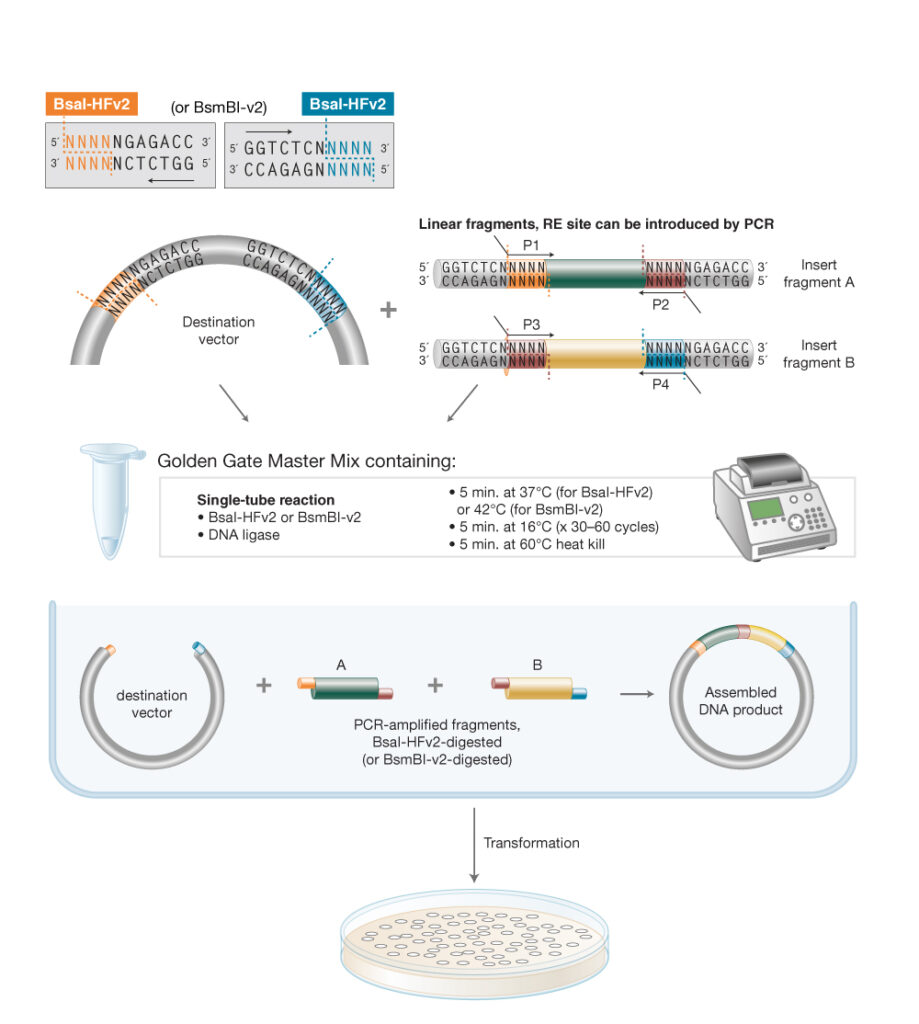
Golden Gate cloning makes use of Type IIS restriction enzymes, such as BsaI, which break DNA outside of their recognition regions. An orderly assembly of a vector and one or more DNA fragments is the end outcome.
Type IIS restriction enzymes differ from "traditional" restriction enzymes in that they produce four base flanking overhangs when they cut outside of their recognition sequence. These overhangs can be tailored to guide the assembly of DNA fragments because they are not a component of the recognition sequence. Proper design prevents the recognition sites from showing up in the finished product, enabling accurate, scarless cloning.
The cloning strategy is as follows: Type IIS sites (such BsaI or BbsI) are included into the gene of interest and placed outside the cleavage site. These sites are therefore removed by digestion/ligation and do not show up in the finished build. Sites with complementary overhangs found in the destination vector guide the final ligation product's assembly. It is possible to ligate a fragment with 5' overhang TGGA and 3' overhang TCCG into a vector that has those overhangs, as demonstrated below. Entry DNA overhangs can be introduced by PCR-based amplification (Option 2) or they can be part of the original plasmid (Option 1).
I attempted to simulate Golden Gate cloning using a Mus musculus p53 backbone and a GFP insert, employing the AcuI restriction enzyme. However, the simulation could not proceed successfully due to incompatible sticky ends between the insert and vector. Additionally, errors occurred during the generation of custom overhangs, which prevented proper assembly of the construct.


Lecture, recitation and slides Benchling
*https://www.neb-online.de/wp-content/uploads/2021/01/GoldenGateOverview_LP_0520_CL_Update_2021-1-919x1024.jpg
https://www.snapgene.com/guides/golden-gate-assembly
https://blog.addgene.org/plasmids-101-golden-gate-cloning
https://byjus.com/biology/pcr/
https://www.neb.com/en/products/b7204-cutsmart-buffer
https://www.thermofisher.com/order/catalog/product/F530S*
https://qb3.berkeley.edu/education/lab-fundamentals-bootcamp/manual/cloning/gibson-assembly/